heyuan962568@gmail.com
+86 18730808985
Hebei, China
Phone: +86 18730808985
Email: heyuan962568@gmail.com
Contact: zihao zu — Sales Director
Moving a patient from a care bed to a rehabilitation, examination or treatment area can be difficult when the patient has limited mobility. The equipment must first be positioned correctly beside the bed, remain stable during assisted transfer and then provide controlled movement to the next care area.
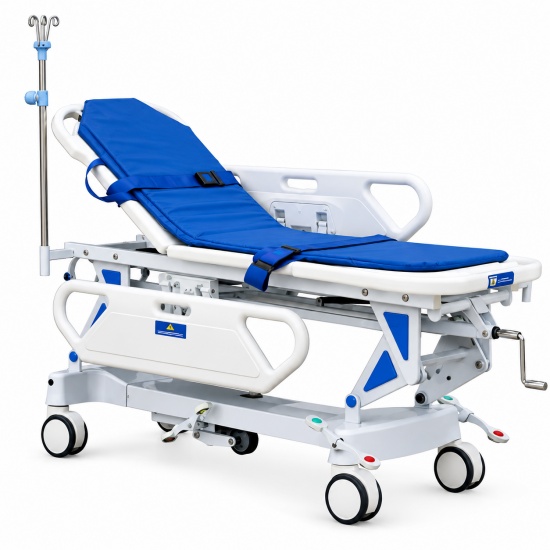
The JH-OCT103 manual patient transfer trolley is designed for this type of professional care workflow. It combines 560–860 mm manual height adjustment with a gas-spring assisted backrest, lift-up ABS side rails, central braking and an independent fifth wheel for directional control.
With a maximum load capacity of 300 kg, the trolley can be used as part of patient transfer routines in rehabilitation centers, community care facilities and other professional care environments.
Before an assisted patient transfer begins, the height of the transport surface can be adjusted from approximately 560 mm to 860 mm.
The adjustment is controlled through a foldable stainless steel manual crank. Turning the crank raises or lowers the entire patient platform according to the required transfer position.
Care beds, nursing beds and other patient-support surfaces may not all have the same height.
Instead of working with a fixed-height trolley, caregivers can adjust the JH-OCT103 before positioning it beside the patient's bed.
This allows the equipment setup to be adapted to the transfer situation before the patient is moved.
The height-adjustment system is mechanically operated and does not require an electric actuator.
This makes the trolley suitable for care environments where straightforward mechanical operation is preferred for routine patient transport equipment.
After the required height has been selected, the stainless steel crank handle can be folded away.
The crank mechanism incorporates bidirectional interference protection and an automatic lubrication function according to the product configuration.
The specified no-load starting torque is no more than 2 N·m.
The trolley is equipped with two ABS lift-up side rails measuring approximately 1080 × 260 × 35 mm.
During transportation, the side rails can remain raised to provide lateral protection around the patient platform.
For bed-to-stretcher transfer, the rail on the working side can be lowered so caregivers can approach the patient more closely.
This is particularly useful when the patient cannot independently reposition or transfer onto the trolley.
The side rail mechanism incorporates gas-spring damping during lowering.
This provides a more controlled movement when the rail is released and allows the same rail system to support both patient access and transport protection.
The backrest can be adjusted from approximately 0° to 75° ±5° using a gas-spring assisted mechanism.
The system is designed for convenient one-hand caregiver operation.
Depending on the patient's care requirements, the back section can therefore be changed between a flatter transport position and a more elevated upper-body position.
The JH-OCT103 has a specified maximum load capacity of 300 kg.
This provides professional care facilities with a clearly defined load specification when evaluating equipment for patients with different body weights and mobility requirements.
The patient's size, clinical condition and the facility's transfer procedure should also be considered when selecting and using patient transport equipment.
Patient transfer should begin with the trolley correctly positioned and secured.
The JH-OCT103 uses four Ø150 mm central-control casters together with a foot-operated central braking system.
Once the trolley has been positioned beside the bed, the brake can be engaged before caregivers begin assisted patient handling.
After the patient is correctly positioned, the side rail can be returned to its protective position and the central brake released before transportation begins.
At the destination, the brake can be engaged again before the next stage of patient handling.
With the central fifth wheel retracted, the trolley moves freely on its four main casters.
This configuration is useful when turning, entering a room or positioning the trolley beside a bed or treatment surface.
When the fifth wheel is engaged, it provides additional directional guidance and helps the trolley maintain a straighter forward path.
This can be useful when patients need to be transported between rooms, rehabilitation areas or treatment spaces connected by longer corridors.
The fifth-wheel mechanism incorporates spring damping to provide additional compliance when passing over uneven sections of the transport route.
Control pedals are positioned on both sides of the trolley for convenient caregiver access.
The trolley is supplied with a 20 mm thick Oxford-fabric mattress.
Two patient safety straps are included in the standard configuration.
When appropriately positioned and used, the straps provide additional patient restraint during transportation and complement the protective function of the raised side rails.
An oxygen cylinder holder is integrated at the head end of the trolley.
The holder is designed for an oxygen cylinder with a diameter of approximately 135 mm.
This allows compatible oxygen equipment to remain with the patient when oxygen support is required during transportation within a professional care facility.
A telescopic stainless steel IV pole is included with the trolley.
IV pole sockets are arranged diagonally at the head and foot ends, giving caregivers flexibility in selecting the pole position according to the patient's treatment and transport requirements.
The trolley uses a one-piece molded engineering-plastic patient platform with integrated handles around the four corners.
These handles provide additional gripping positions when caregivers need to push, pull or make smaller positioning adjustments.
This can be particularly useful when aligning the trolley beside a care bed or maneuvering it within a treatment room.
The main structure is manufactured from welded carbon steel and finished with electrostatic powder coating.
The frame provides the structural foundation for the manual lifting mechanism, patient platform and mobility system.
The main longitudinal members use 50 × 30 × 2 mm rectangular hollow steel, while the triangular support components are formed from 2.5 mm cold-rolled steel plate.
Move the trolley to the required side of the bed with the fifth wheel retracted when greater maneuverability is needed.
Use the manual crank to raise or lower the patient platform according to the bedside transfer situation.
Secure the trolley before beginning patient handling.
Lower the ABS side rail to create closer lateral access for the caregivers assisting the patient.
After the patient has been transferred onto the trolley, adjust the backrest when required and return the side rail to its protective position.
Use the two safety straps appropriately according to the patient's transport requirements.
Release the central brake before movement. Keep the fifth wheel retracted when multidirectional maneuverability is required, or engage it when directional assistance is useful on a longer transport route.
After reaching the rehabilitation, treatment or care area, apply the central brake before further patient handling begins.
The trolley can support patient movement between care beds, rehabilitation areas and other treatment spaces within a rehabilitation facility.
For facilities caring for patients with limited mobility, adjustable height and lowering side rails can support caregiver-assisted transfer routines.
The combination of patient support, manual height adjustment and controlled mobility makes the trolley suitable for professional environments where patients need repeated movement between different care areas.
Where the physical environment and professional care plan are suitable for medical transport equipment, the trolley can also support trained care teams managing patients who require assisted movement.
Model: JH-OCT103.
Product Type: Manual Patient Transfer Trolley.
Overall Size: 1930 × 640 × 560–860 mm.
Height Adjustment: 560–860 mm.
Lifting System: Manual crank mechanism.
Crank Handle: Foldable stainless steel.
No-Load Starting Torque: ≤2 N·m.
Backrest Adjustment: 0–75° ±5°.
Backrest System: Gas-spring assisted.
Maximum Load Capacity: 300 kg.
Frame: Welded carbon steel.
Surface Finish: Electrostatic powder coating.
Main Longitudinal Beam: 50 × 30 × 2 mm rectangular hollow steel.
Triangular Support: 2.5 mm cold-rolled steel plate.
Patient Platform: One-piece molded engineering-plastic platform.
Side Rails: ABS lift-up side rails with gas-spring damping.
Side Rail Size: 1080 × 260 × 35 mm.
Main Casters: 4 × Ø150 mm central-control casters.
Braking System: Central brake.
Directional System: Retractable central fifth wheel.
Fifth Wheel: Ø100 mm.
Fifth-Wheel Suspension: Spring damping mechanism.
Oxygen Cylinder Holder: Suitable for approximately Ø135 mm oxygen cylinder.
IV Pole: Telescopic stainless steel IV pole.
Mattress: 20 mm Oxford-fabric mattress.
Safety Straps: 2 pcs.
Net Weight: 75 kg.
Gross Weight: 108 kg.
Packing Method: Full wooden case.
Packing Size: 1990 × 740 × 670 mm.
The JH-OCT103 is intended for facilities that need a practical way to move reduced-mobility patients between beds and different care areas.
Its 560–860 mm manual height adjustment supports bedside positioning, while lowering side rails provide caregiver access during assisted transfer. Once the patient is ready to move, the central caster system and fifth wheel provide two different mobility modes for room positioning and longer transport routes.
Explore our Patient Transfer Equipment range for additional patient transport solutions.
For patients who require long-term bedside care, explore our Nursing Bed range for additional home care and rehabilitation bed solutions.
For product specifications, bulk purchasing, available configurations or OEM/ODM requirements, contact us with your requirements.

The nursing beds meet our daily care requirements very well. The products arrived in good condition, and the overall purchasing experience was smooth and professional.

We were looking for a supplier that could provide stable quality and flexible OEM service. Their responsiveness and product consistency have helped us grow our business.
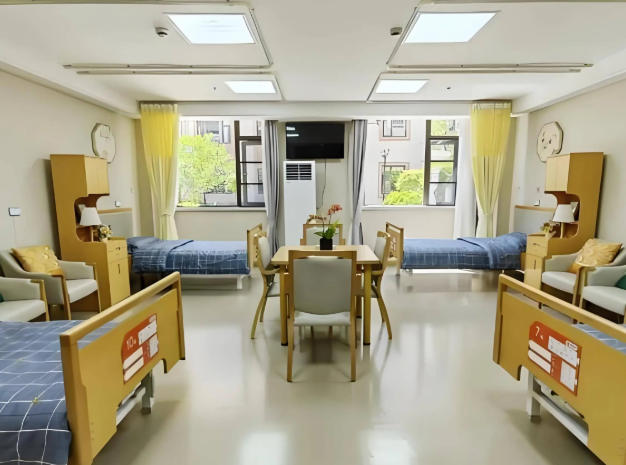
The care beds are comfortable, easy to operate, and well received by both residents and caregivers. The team provided helpful support throughout the purchasing process.

We have purchased care beds for several projects, and the product quality has been consistent. Communication was clear, and delivery was arranged on schedule. A reliable supplier to work with.
Yes. We provide OEM and ODM services for care beds, nursing beds, and healthcare furniture, including customization of functions, colors, logos, packaging, and specifications.
Our products are manufactured under ISO 9001 and EN ISO 13485 quality management systems. Specific certifications may vary depending on the product model and market requirements.
Production time depends on the product type and order quantity. Most standard care bed orders can be arranged within the agreed production schedule.
MOQ varies by product model. Please contact us with your requirements, and we will recommend the most suitable purchasing solution.
Yes. We provide product guidance, technical documentation, and responsive after-sales support to help customers use and maintain our care beds efficiently.
Send us your requirements today and receive fast support, product details, and factory pricing within 24 hours.
+86 18730808985
Mon-Fri, 8am-6pm CST
heyuan962568@gmail.com
We reply within 24 hours
+86 18730808985
Instant messaging available
Yintai Industrial Park, Jizhou District, Hengshui City, Hebei Province, China
